Excavating Antioch: The Archaeology of an Ancient City
The 1930s excavations at Antioch (modern-day Antakya, Türkiye) have shaped how the ancient city is known today. Yet the colonial, institutional, and political frameworks that structured these excavations have obscured key aspects of their history, including the origins of finds, the system of partage, and the ethical implications of archaeological removal.
Excavating Antioch, which I co-lead with Dr Elizabeth Molacek, re-examines this legacy by bringing together dispersed artifacts, excavation archives, and new scholarship to reconstruct both ancient Antioch and the modern histories that shaped its interpretation.
Why Antioch?
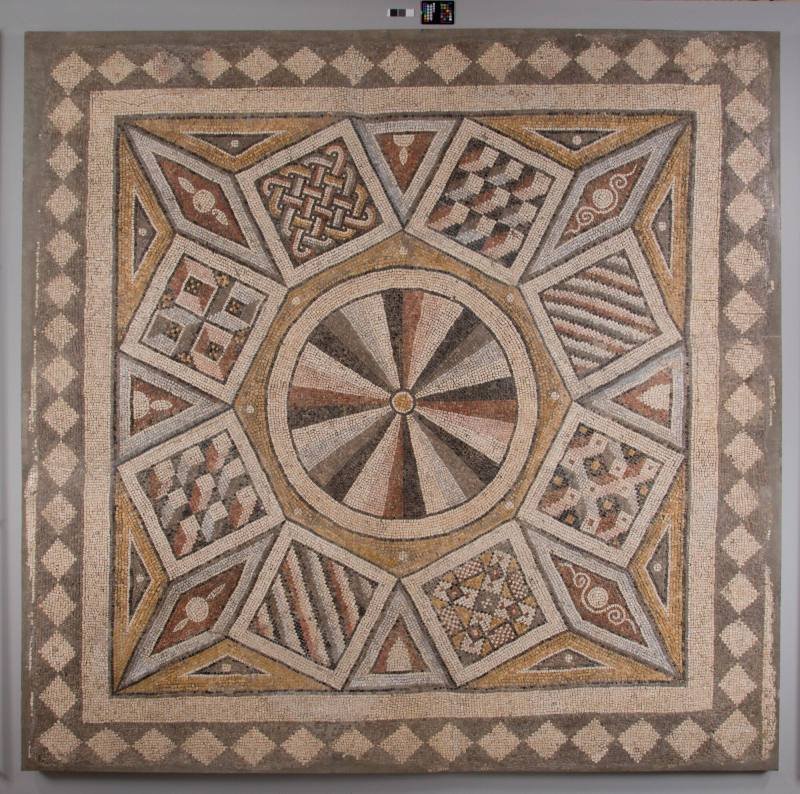
Founded in 300 BCE, Antioch-on-the-Orontes was one of the major urban centers of the ancient Mediterranean. Its diverse population and monumental architecture made it a site of extraordinary cultural and artistic production, particularly in mosaics, architecture, and urban design.
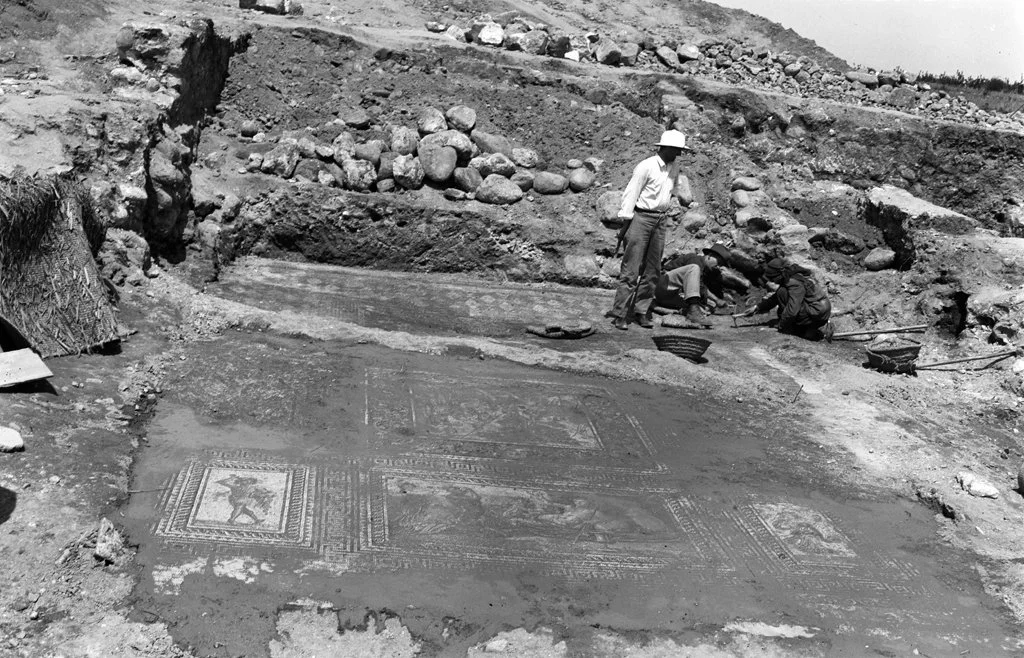
Yet Antioch is also a city defined by its excavation history—by what was recovered, divided, and dispersed through early twentieth-century archaeological practice.
This project focuses on the overlooked: small finds, architectural fragments, and domestic materials that reveal the textures of everyday life.
Methodology
Excavating Antioch began with a simple but urgent question: How and why did so much material from Antioch end up in museum collections abroad? This research project brings these artifacts, many long hidden in storage, into view and highlights overlooked stories. By weaving together objects, archival evidence, and scholarly insight, we can better understand the ancient city.
The project combines archaeological, archival, and curatorial research, drawing on digitized excavation records from Princeton University alongside object collections in U.S. museums.
A central interpretive tool is the Princeton grid system (e.g., 15-M, 13-R, 16-P), which allows objects to be re-situated within the ancient city’s spatial structure.
The project also critically engages the system of partage, through which artifacts were divided between host countries and foreign institutions, shaping both museum collections and modern understandings of Antioch.
While we cannot change the conditions under which these objects were originally excavated, documenting and presenting their full histories is a step toward greater transparency and responsible stewardship.
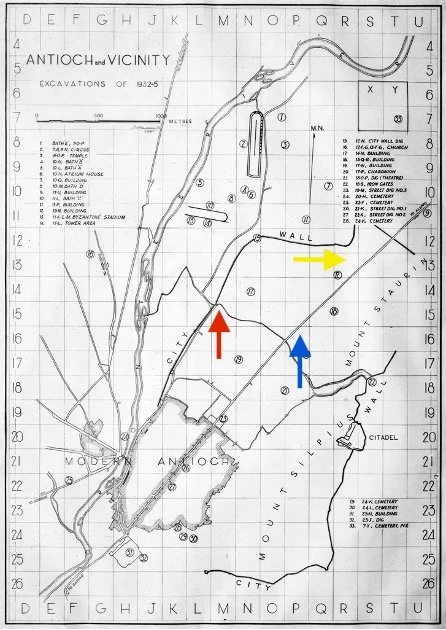
Map of Antioch with the Marble Workshop (16-P) in blue; House of Aion (15-M) in red; Bath Complex F (13-R) in yellow.
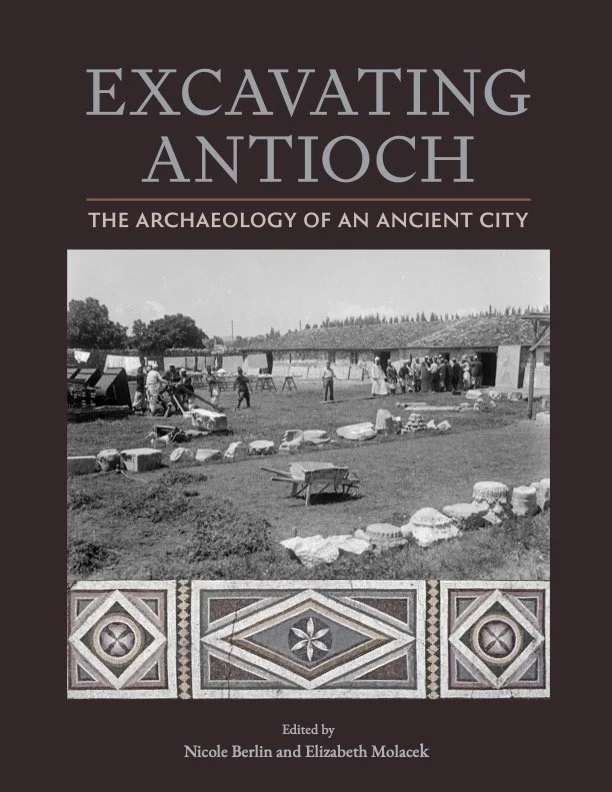
Excavating Antioch Book
The Essays
The essays in this catalogue bring together new research on Antioch’s ancient urban life and the history of its excavation and afterlives. Across two sections, contributors examine the city’s mosaics, architecture, and regional connections in antiquity, as well as critical studies of the 1930s excavations, institutional partnerships, and the systems by which Antioch’s material culture was recorded, divided, and distributed. Together, these essays frame Antioch as both an ancient Mediterranean city and a modern archaeological construct shaped by colonial-era practices and ongoing scholarly interpretation.
The Object Catalogue
The object catalogue documents materials from four institutions—the Baltimore Museum of Art, the Worcester Art Museum, the Harvard Art Museums, and Dumbarton Oaks—whose Antioch collections range from fully catalogued and photographed objects to works that have never been systematically documented or made publicly available. This section presents the results of three years of collaborative research led by Nicole Berlin with Wellesley College students, bringing together archival reconstruction, object analysis, and new documentation to re-establish connections between artifacts and their excavation histories. By linking these objects to the Princeton Antioch archives and related excavation records, the catalogue provides a consolidated, accessible resource for the study of Antioch’s material culture and its dispersed archaeological legacy.
The Exhibition
Opening on 25 September 2026 at the Davis Museum at Wellesley College, the Excavating Antioch exhibition traces Antioch-on-the-Orontes (modern-day Antakya, Türkiye) through two histories: the ancient city, from the Hellenistic period through the 12th century CE, and its excavation in the 1930s. In antiquity, Antioch was one of the Roman Empire’s major urban centers, where homes, workshops, and public baths reveal a vibrant civic and social life shaped by daily interaction and material exchange.
In the 1930s, Princeton University led excavations in Antakya with European and American partner institutions under the French Mandate for Syria and Lebanon. Working within the system of partage, artifacts were divided among institutions, shaping both what was preserved and how Antioch is known today. The exhibition traces these layered histories, following objects from excavation to museum collections and inviting reflection on how archaeological knowledge is made.